For newcomers
Frequently asked questions
Coming to a Holy Mass in the traditional Roman rite for the first time? Then you probably have questions. Here are answers as we often give them.
- You can just come. No registration, no admission.
- You don’t need to know anything. No Latin, no prior knowledge.
- We are Catholic. A parish of the Diocese of Chur.
First things first
Before you come for the first time
-
Are you in full communion with Rome?
Yes — without any reservation. We are part of the Diocese of Chur. Bishop Vitus Huonder erected our personal parish for the Canton of Zurich on 22 February 2012. Its pastoral care is entrusted to the Priestly Fraternity of St. Peter, a community of Catholic priests founded in 1988 and recognised by Pope John Paul II.
At every Holy Mass we pray by name for the Pope and for our bishop. Our sacraments are valid and licit. Anyone who attends Sunday Mass with us fulfils their Sunday obligation.
-
Can I simply come to Mass?
Yes. There is no registration, and admission is free. It is best to come a few minutes before the start and take a seat anywhere. Simply watch and listen, and let the sacred rites speak to you.
If you like, you can speak to the parish priest after Mass.
-
I am not Catholic — or haven’t been to church in a long time. May I still come?
You are most welcome. Everyone who wishes to pray, to listen or simply to have a look is invited to Holy Mass.
Holy Communion, however, is received only by Catholics who are in the state of grace. Then simply stay in your place. That is perfectly normal and nothing to feel uncomfortable about.
The Holy Mass
What happens in church
-
Does the priest turn his back on the people?
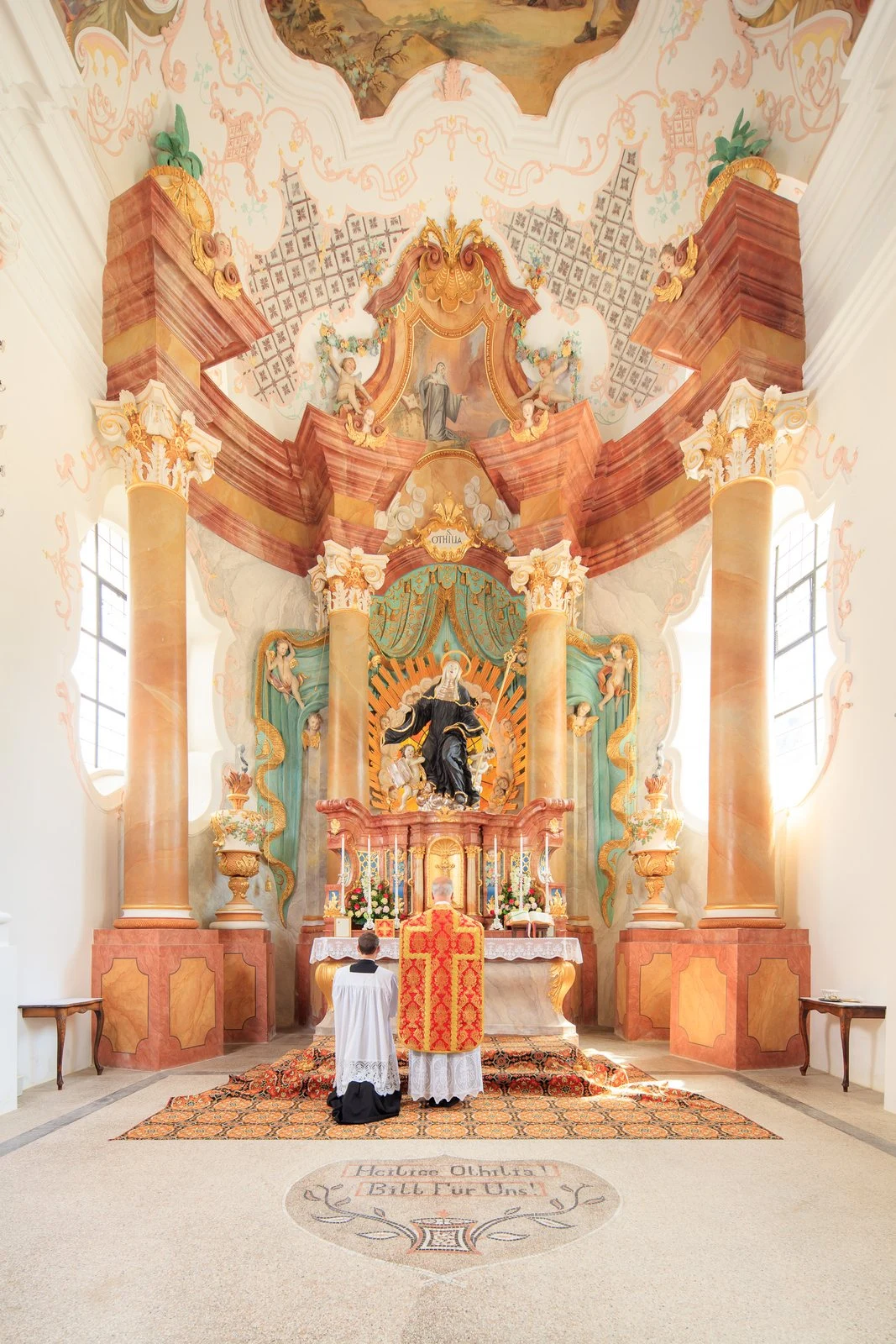
In the traditional rite, priest and congregation are turned together towards Christ. Holy Mass is not about facing or watching the priest. Rather, we all look to God together. That is why we deliberately keep the ancient custom of celebrating versus Deum – turned towards God.
-
What is a Holy Mass in the traditional rite like?
Holy Mass begins with the prayers at the foot of the altar and the psalm verse: “I will go in unto the altar of God.” On Sundays and feast days much is sung, other parts are prayed quietly. At the Consecration, the high point of the Mass, there is reverent silence.
We have described the order of Mass in more detail.
Ask for our free booklet “Zum Altare Gottes will ich treten” (in German)! It is simply written and will help you understand the Mass better.
-
How long does a Holy Mass last?
That depends on how solemnly the Holy Mass is celebrated. On ordinary weekdays it lasts about 35 minutes. On Sundays, with Gregorian chant, organ music and a sermon, it lasts a little over an hour.
To prepare yourself spiritually, on Sundays you can come as early as 16.00 for Benediction with Confessions and the Rosary. Holy Mass begins at 17.00 and usually ends at 18.10.
All times and places are listed under Masses & times.
-
I don’t understand Latin. Can I still take part?
Yes. You don’t need to know Latin. The Epistle and the Gospel are read in German, and so is the sermon.
To begin with, you can simply watch and listen. In their timeless beauty, the liturgical prayers and Gregorian chants can touch the soul.
To pray along, we provide bilingual booklets free of charge. As you become familiar with the sacred texts, you may discover how the Latin language of worship in particular can open a special way into the Eucharistic mystery.
Incidentally: the Second Vatican Council expressly spoke in favour of retaining Latin in the celebration of Holy Mass.
-
Which books should I pick up?
At the entrances you will find free red booklets titled Ordo Missæ. Feel free to take one to your seat. It contains the unchanging parts of the Holy Mass in Latin and German, as well as the hymns that are sung.
The texts that change from day to day – the Epistle, the Gospel and the prayers of the day – are not included. If you would like to follow those too, you can buy a hand missal from us.
If you attend Mass regularly, we recommend getting your own Ordo Missæ in the hardcover edition. We use it as our hymnal. This edition is more comfortably made and contains the music for the hymns as well as the texts.
-
When do I stand, kneel or sit?
Simply watch what the people around you do. Nobody will mind if, when in doubt, you stay seated.
The right posture comes naturally in a short time. When the congregation usually stands, kneels or sits is explained on page 7 of the Ordo Missæ booklet. A quick look inside can take away the uncertainty.
-
How do I receive Holy Communion?
Holy Communion is for us the holiest of all. That is why we conscientiously keep to the order of the Church. You will find an explanation on page 69 of the Ordo Missæ booklet.
Whoever receives Holy Communion must be Catholic and in the state of grace, and must have kept the Eucharistic fast of at least one hour.
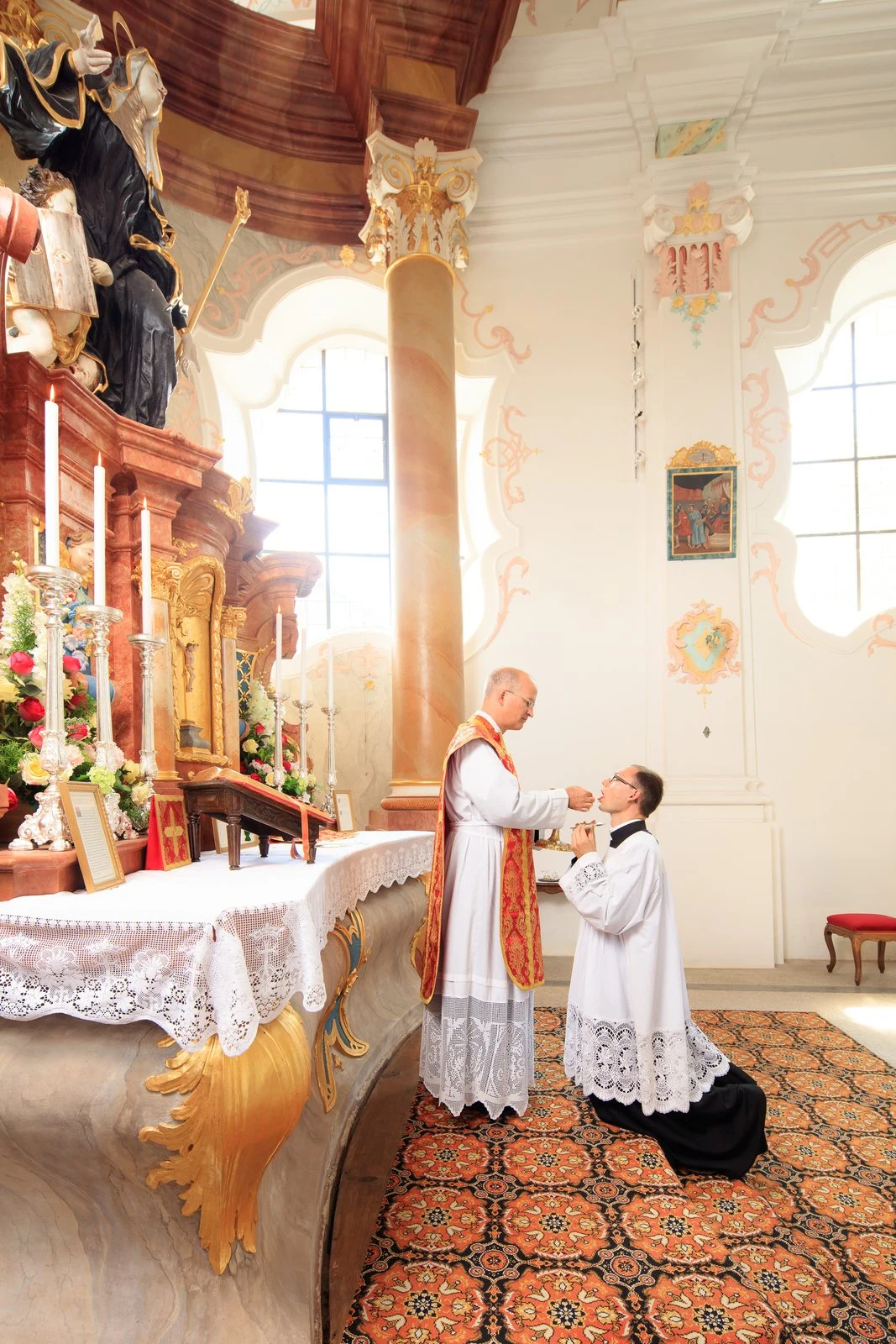
In the traditional Roman rite, Holy Communion is received kneeling, on the tongue. Receiving the Blessed Sacrament in the hand is not possible. The faithful kneel at the altar rail. When the priest comes before them, they open their mouth and rest their tongue on the lower lip. In this way they receive the Sacrament reverently, without saying “Amen”.
Only the priest speaks: “May the Body of our Lord Jesus Christ preserve your soul unto life everlasting. Amen.”
Whoever does not receive Communion, for whatever reason, simply stays in their place.
If you have questions about receiving Holy Communion, feel free to speak to the parish priest at any time.
Dress and manners
How things are done here
-
What should I wear?
We have no dress code. Even so, it is fitting to dress worthily in a holy place. Here we are neither on the sports field nor at the beach. Clothing should express dignity and reverence. On Sundays and feast days it is quite appropriate to dress a little more festively on purpose.
In any case, you are welcome even if you come straight from work or from a mountain hike. Nobody is looked up and down at our door.
-
Do women have to cover their heads?
No, not at all. In some cultures it is customary for women to wear a headscarf, a hat or a mantilla. That is why some women wear a veil to church. With us, however, it is rather uncommon.
-
We are coming with small children. Is that a problem?
Quite the opposite — children belong in church, and our parish is young and family-friendly.
It is normal for small children to make noises now and then. Nobody should give you a disapproving look for it.
A practical tip: a seat near the exit makes it easier to step out and come back, should you ever need to leave the church for a moment.
If you have any questions or concerns about this, feel free to speak to the parish priest.
Practical matters
Getting here, Confession, sacraments
-
How do I find the church?
For many years our personal parish has been a guest in the parish church of Herz-Jesu in Zurich-Oerlikon, Schwamendingenstrasse 55. It is about a ten-minute walk from Oerlikon station. Alternatively, take bus 75 from “Sternen” to “Dorflinde” or “Friedacker”.
A map and all the other places — the house chapel in Thalwil and St. Anthony’s pilgrimage church in Egg — are under Getting here.
-
When can I go to Confession?
On Sundays during Benediction from 16.00 to 16.45, and on Mondays and Fridays from 18.00 to 18.45. In Thalwil, Confession is possible at any time by arrangement.
Home visits, pastoral conversations and Communion for the sick are likewise possible at any time.
The current Confession times are listed together with all services under Masses & times.
-
Does it cost anything to come?
No. On Sundays a collection is taken up during Holy Mass, with which the parish funds its work. Give what you wish – or simply pass the basket on.
Our personal parish receives no church tax. If you would like to support it beyond that, you will find bank details and TWINT under Donate.
-
Can baptisms, First Communions, Confirmations or weddings be celebrated here in the traditional rite?
Yes. The sacraments are celebrated here in the traditional Roman rite. Catechesis for children and adults, marriage preparation, and instruction for converts or candidates for baptism can be arranged individually.
Speak to the parish priest or write to us — and we will discuss everything else in person.
Another question?
Just ask us
Anything you do not find here we are glad to answer in person – after Mass or by email. Do not hesitate to speak to us!